#90daysofdevops
DevOps Tools :
In the ever-changing world of software development, DevOps has become super important for making things run smoothly and boosting productivity. Let's explore some of the most popular DevOps tools that can help you automate and enhance your workflows.
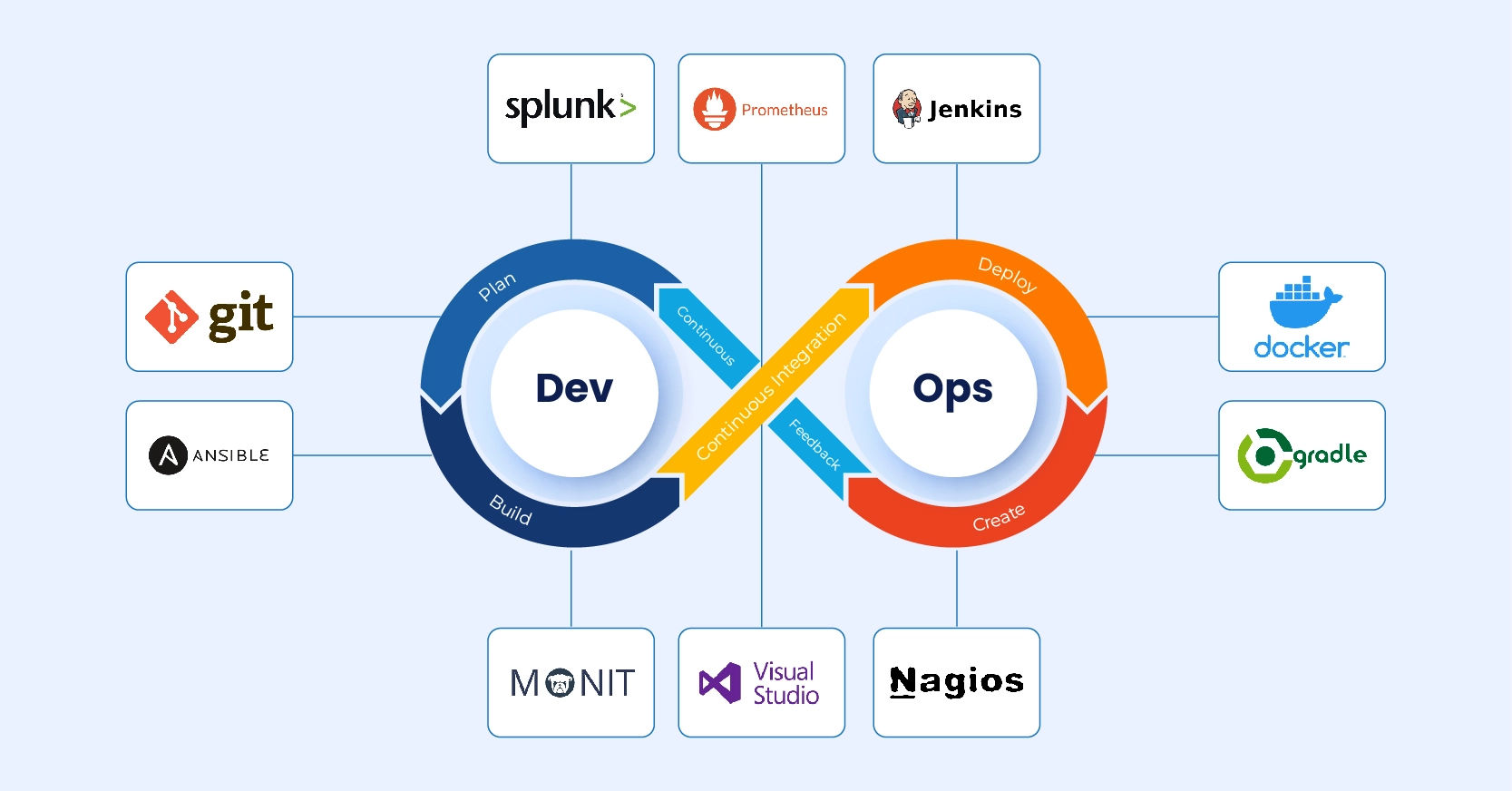
🚀 Jenkins
Jenkins is an open-source automation server that makes continuous integration and continuous delivery (CI/CD) a breeze. It supports a ton of plugins to expand what it can do.
Key Features:
Easy installation and configuration
Extensible with plugins
Strong community support
🐋 Docker
Docker is a platform that allows developers to automate the deployment of applications inside lightweight, portable containers.
Key Features:
Simplifies configuration
Increases developer productivity
Enables microservices architecture
🌐 Kubernetes
Kubernetes, also known as K8s, is an open-source system for automating the deployment, scaling, and management of containerized applications.
Key Features:
Automated rollouts and rollbacks
Service discovery and load balancing
Storage orchestration
🛠️ Ansible
Ansible is an open-source automation tool used for IT tasks such as configuration management, application deployment, and intra-service orchestration.
Key Features:
Simple, agentless architecture
Uses YAML for configuration
Integrates easily with other tools
📊 Prometheus
Prometheus is an open-source monitoring and alerting toolkit designed for reliability and scalability. It's particularly well-suited for complex, multi-node environments.
Key Features:
Powerful query language (PromQL)
Multi-dimensional data model
Alert manager for handling alerts
☁️ Terraform
Terraform is an open-source infrastructure as code (IaC) software tool that provides a consistent CLI workflow to manage hundreds of cloud services.
Key Features:
Infrastructure as Code (IaC)
Supports multi-cloud environments
Dependency graphing
📈 Grafana
Grafana is an open-source analytics and monitoring platform for databases. It allows you to query, visualize, alert on, and understand your metrics no matter where they are stored.
Key Features:
Customizable dashboards
Supports multiple data sources
Advanced alerting options
Using these DevOps tools can greatly improve your development, deployment, and operations. Each tool has its own strengths, so it's important to pick the right mix for your needs. Happy DevOps-ing! 🚀
About the author
👋 Hello! I'm Pratiksha Satpute, an aspiring DevOps Engineer on an exciting journey of mastering the DevOps lifecycle. Currently, I'm deeply immersed in the 90DaysOfDevOps challenge, where I explore and conquer daily tasks involving Linux, Docker, AWS, Git, and more.
🌱 Every day brings a new learning experience, from configuring and managing Docker containers to automating tasks with cron jobs, and mastering Git and GitHub for efficient version control. I am passionate about understanding the intricacies of DevOps tools and practices, and I continuously strive to enhance my skills and knowledge.
🚀 I enjoy sharing my progress and insights through blog posts, aiming to help and inspire others in the tech community. Join me on my journey as I navigate through the world of DevOps, and let's learn and grow together!
💬 Connect with me to discuss DevOps, Docker, cloud computing, or anything tech-related. I'm always open to new ideas, collaborations, and opportunities to learn from fellow enthusiasts.
Comments
Join the discussionNo comments yet. Be the first to comment.

